
Active Stand Aids: A Patient Journey
Oxford Healthcare is one of the world’s leading suppliers of patient handling equipment and rehabilitation products. We are the home of Oxford Hoist, a leading name in the design and manufacture of leading patient handling solutions. We provide an extensive range of lifting solutions, including stand aids, often referred to as active style hoists. They demand a more active user to participate in the lifting process.
What Is A Stand Aid?
A stand aid is a patient lifting device, designed to assist those who have difficulty rising from a seated position to standing. An active standing hoist is used by people with limited or reduced mobility, such as the elderly, who may have naturally lost a degree of balance or strength. It is important to risk assess the use of a stand aid before use and to ensure consideration is given to the patient’s function, including weight-bearing ability.

There are different types of stand aid that offer varying levels of assistance. These can be broadly placed into three categories: patient turners, manual stand assist devices and electrically operated stand aids. They each have their unique applications and suitability, dependent on patient conditions and environmental factors.
A journey of care for an elderly patient might begin with the prescribed use of a patient turner. Should their strength and abilities reduce over time and following further assessment, a transition to a manual stand assist device or even an electric stand hoist could be considered a naturally progressive path of care. A passive hoist could be the next step if a patient becomes more dependent on assistance.
Standing Aids | The Oxford Switch
Patient turners, such as the Oxford Switch, are some of the more basic designs, consisting of a wheeled footplate with an upright, angled frame which is used as a stabilising hand-hold for the carer and for the patient to use for leverage when standing from a seated position. These devices do not have a seat and the patient will remain standing throughout the transfer. A handling belt can be used for additional support and carer assistance if required.
Manual stand assist devices are the next stage. They are used in a similar way to patient turners with the added benefit of integrated seat pads for patients, especially for those who do not necessarily have sufficient strength to stand for long periods. They provide a more stable and reassuring means of transfer and a handling belt or sling may be used in combination with these products for added support.
Electrically operated stand aids take away a lot of the manual work associated with the standing process, both for the patient and the caregiver. A powered actuator and handset combination handles the raise action with minimal effort. Caregivers use these lifts with a sling to facilitate the standing process. Although these lifts do not have a seat, a Transport style sling with leg sections will achieve a secure seated position prior to transfer.

Using A Stand Aid
When it comes to using any stand aid such as the Oxford Journey, care professionals and of course patients will benefit from the assistance it provides. A stand aid or stand assist device offers a unique form of assistance that enables care professionals to raise patients into a standing position without the exertion and strain of performing a manual lift. This reduces musculoskeletal injuries and lost time and money for care facilities due to staff absence. It also requires a degree of user participation, thus encouraging and helping to maintain or restore patient function and independence over time.
There is a small selection of slings that are compatible with stand aids, the most common being a belt style design. This style of sling fits around the waist of the patient and attaches to the ‘cow-horn’ of the stand aid using either two looped straps or, in some cases, clip attachments. In addition, Oxford Healthcare offer the Oxford Transport sling which also fits around the waist of the patient but incorporates padded leg sections, which can facilitate a seated transfer.
Before using a stand aid, caregivers must carry out a thorough dynamic risk assessment to determine suitability for the patient, the activity, and the environment. Unlike most passive hoist and sling combinations, the use of an active style stand aid demands a degree of effort and ability on the part of the patient. For this reason, it is important to have confidence in both their physical and cognitive abilities.
The Oxford Journey Stand Aid
The Oxford Journey is an incredibly versatile, electrically operated, active stand aid. Its unique, adjustable cow-horn offers three different height settings for a range of patient heights; a cushioned, adjustable height kneepad offers excellent support and comfort; adjustable leg positioning for navigating chairs and other furniture, as well as a removable foot-tray for support with rehab tasks.
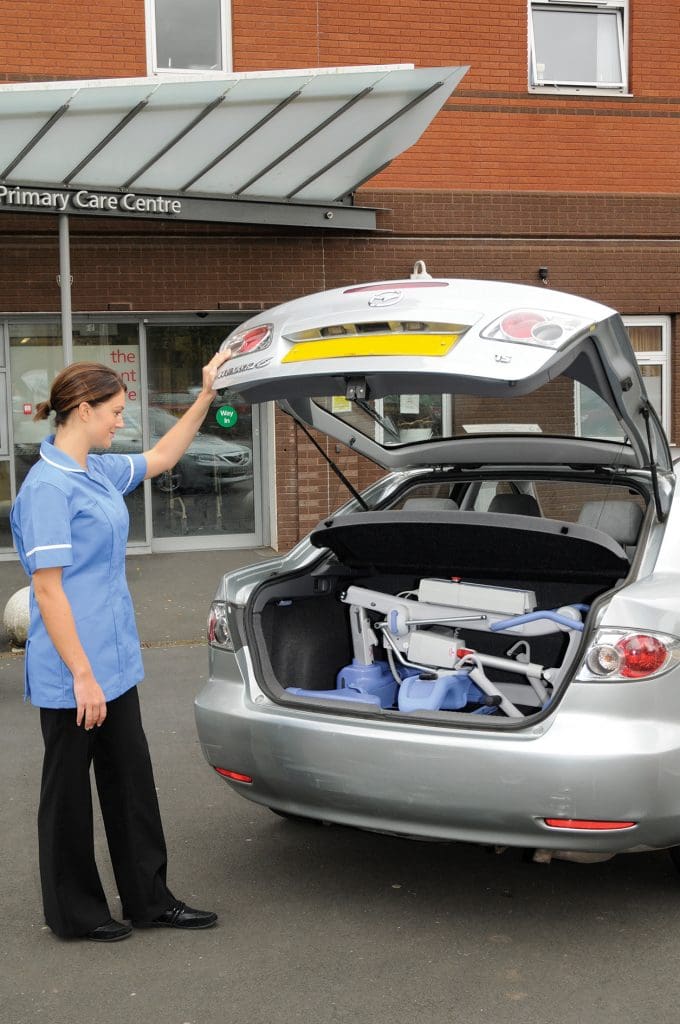
Unlike most stand aids on the market, the Journey is quickly and easily foldable (without tools), ensuring ease of storage and transportation. With this functionality, the Oxford Journey makes it easier for users to travel outside the confines of their home, fitting comfortably into the boot of most family saloon cars.
Another useful feature of the Journey stand aid is the Smart Monitor control system. This intelligent system provides a comprehensive lift cycle count, records attempted overloads (above safe working load), it has a suite of safety devices and has a programmable service reminder. This functionality helps keep your lift in perfect and safe working order for longer.
Two active sling styles specifically complement the Oxford Journey. The Deluxe Standing and Deluxe Transport slings.
Contact Us Today
Would you like to find out more about our active stand aids, including the Oxford Journey? Then explore our website today. With a wealth of experience and expertise, our team can support you with finding the most suitable solution. Would you like to speak to a member of our helpful and friendly team? Then can call +44 (0)344 811 1158 to discuss your requirements.